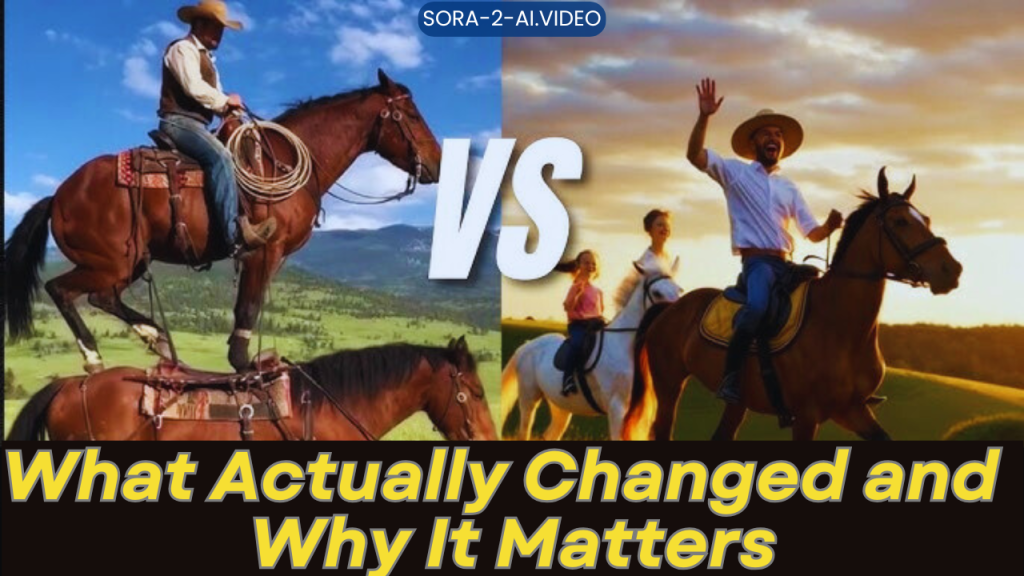
The jump from “Sora” to “Sora 2” is one of those product evolutions that looks incremental on the surface — a new version number, some demo reels — but actually signals a meaningful change in capability, use-cases, and the broader AI video landscape. Sora started as a promising text-to-video model and social app that could turn short prompts into short clips; Sora 2 pushes the envelope on realism, physical coherence, audio synchronization, and creative control. Below I unpack the concrete technical and product differences, explain why they matter for creators, businesses, and policymakers, and give a grounded sense of where this technology is likely to go next.
Short summary: the headline changes
If you want the TL;DR: Sora 2 is more physically accurate and realistic, produces longer and more coherent scenes, supports synchronized dialogue and sound, provides better user controls and character continuity, and ships as a fast, flexible model family with different variants for iteration vs. fidelity. Those improvements make Sora 2 effective not only for social short-form content but also for higher-stakes creative tasks like previsualization, training simulations, and polished marketing materials.
What changed — technical and product details
1. Physics, spatial coherence, and motion realism
One of the biggest technical leaps in Sora 2 is its improved modeling of the physical world. Earlier text-to-video models (including Sora) often produced plausible frames but struggled with consistent object geometry, believable human motion, and continuity across shots. Sora 2 reduces these failure modes: motion looks more natural, objects maintain consistent shapes and positions between frames, and interactions obey simple physical constraints (for example, collisions and inertia feel more plausible). This is not merely cosmetic — better physical coherence means fewer “jarring” artifacts in medium-length scenes and more trust that the system can be used for scenarios where physical behavior matters (training simulations, product visualization, sports replays, stunt choreography).
2. Synchronized audio and dialogue
The original Sora could create visuals that suggested speech or sound, but synchronization and sound design were limited. Sora 2 explicitly supports synchronized dialogue and sound effects, meaning generated characters can speak with timing that matches lip movement and scene events can trigger appropriate audio cues. For creators this is huge: it eliminates the tedious post-production step of matching separate audio to generated footage, and it makes storytelling through AI-generated clips far more immediate and compelling.
3. Longer, more coherent outputs and character continuity
Sora 2 is designed to produce longer sequences with better narrative coherence. A related product improvement is the idea of character cameos and reusable “characters” you can tag and bring back across scenes. That means you can create a persona (or a stylized avatar) once and reuse it consistently, enabling episodic storytelling or branded characters across multiple videos. The feature improves creative workflows and reduces the need to craft complex prompts from scratch every time.
4. Two model variants: speed vs fidelity
Sora 2 is released as a family of models tuned for different purposes. One variant prioritizes speed and quick iteration — great for brainstorming, social posts, and prototype cuts — while another emphasizes higher fidelity and physical realism for polished outputs. This dual-variant approach acknowledges a common workflow: rapid ideation followed by a slower pass for final quality. It also lowers the barrier for experimentation because creators can iterate cheaply and then switch to higher-quality renders for finalization.
5. Better controls and interfaces
Sora 2 accompanies improved UI affordances for directing camera motion, style, and pacing. The Sora app and platform tools now expose higher-level controls so users can steer not only what appears on screen but how it feels: camera lens choices, lighting presets, gesture anchors, and scene continuity settings. That translates into fewer frustrating “random” outputs and more predictable creative control.
Why these changes are important
For creators and small teams
The practical takeaway for creators is time and capability. With synchronized audio and stronger motion realism, a one-person creator can produce a significantly more polished short film or branded clip without a camera crew, actors, or a full post-production pipeline. Reusable characters and faster iteration cycles also mean creators can build IP — recurring personas and series — more rapidly. This democratizes content creation but also raises competition: lower production friction increases content volume and raises the bar for originality.
For businesses and marketing
Marketing teams and small studios gain a rapid prototyping tool for storytelling and ad creative. Sora 2’s fidelity options mean a marketer can iterate dozens of creative variants quickly (speed model) and then generate final assets (fidelity model) for distribution, cutting agency costs and shortening time-to-market. The tool also makes dynamic, personalized video ads plausible: imagine swapping product variants or localizing scenes on the fly for different audiences.
For research, simulation, and training
Because Sora 2 models physics and spatial consistency better, the tool starts to be useful beyond entertainment: rapid scenario simulation (e.g., human movement studies, safety demonstrations, virtual rehearsals) becomes feasible. While Sora 2 isn’t a substitute for dedicated physics engines or human-subject research, it offers a low-cost sandbox for imagining and visualizing scenarios before committing resources.
For content moderation and policy
Increasing realism amplifies the ethical stakes. Better deepfakes, realistic reenactments, and easily generated celebrity-style scenes force platforms and policymakers to revisit guardrails, provenance systems, and user consent models. Industry moves like licensing deals (e.g., major IP holders starting to partner with generative platforms) and content labeling become more urgent as realism makes misuse easier and harder to detect.
Risks and limits — what Sora 2 still doesn’t solve
No model is perfect. Sora 2 is a clear step forward, but limits remain:
- Long-form narrative coherence: While scene-level coherence improved, long-form storytelling (feature-length coherence, complex character arcs) is still beyond the reliable scope of a single automated generation pass.
- Precise human likeness and legal/ethical constraints: Sora 2 can generate convincing people and voices in a way that risks impersonation. Responsible use policies, opt-in licensing, and technical provenance are still necessary.
- Edge-case physics and nuanced interactions: The model handles many physical interactions better, but can still fail on intricate multi-object dynamics, reflective lighting, or fine-grain facial micro-expressions.
- Bias and content-safe behavior: As with all generative systems, Sora 2 can reflect, amplify, or invent biases unless explicitly checked with safety filters and guardrails.
Ecosystem and business implications
Sora 2’s arrival shifts value across the content chain. Platforms gain new engagement hooks — AI-generated short videos, branded character cameos, and personalized ads — while production houses must adapt by focusing on premium creative direction, IP, and authenticity. Meanwhile, companies with large IP portfolios are already eyeing partnerships and licensing models that let them control how their characters appear in AI-generated content; those deals will shape which IPs appear where and under what restrictions. Expect licensing, provenance metadata, and verification systems to grow in importance.
Practical tips for users who want to adopt Sora 2 today
- Start with the speed variant for ideation. Use the fast model to explore tone, framing, and style; only switch to the high-fidelity variant for final renders.
- Leverage character tagging. Create reusable characters early in your workflow to maintain continuity across episodes or ad series.
- Plan audio early. Take advantage of synchronized dialogue features to write and iterate scripts that are designed for immediate playback, saving post-production headaches.
- Respect rights and provenance. If you plan to generate content with real people or IP, check licensing rules and use the platform’s consent and attribution features.
- Use human-in-the-loop review. Automated generation is powerful but still benefits from human editorial oversight — for ethics, quality, and context.
Where this likely leads next
The logical next steps are specialization and tooling: more domain-specific Sora variants (e.g., sports motion Sora, architectural visualization Sora), better integration with editing suites, and richer APIs for interactive, real-time generation. We’ll also see parallel growth in verification tech (cryptographic provenance, automated deepfake detectors) and commercial models for licensing character likenesses and IP. Finally, as these models get embedded into social and creative apps, cultural norms and legal frameworks will evolve — not instantly, but quickly enough that creators and companies need to be proactive.
Conclusion
Sora 2 isn’t just a faster Sora; it’s a more capable one. The advances in physical realism, audio synchronization, scene coherence, and user controls expand the set of useful applications from playful short clips to commercially relevant marketing assets and rapid simulations. That expansion brings big creative opportunities and serious ethical and policy questions. For creators and businesses, Sora 2 lowers the technical barrier to producing convincing video. For society, it raises the urgency of thoughtful guardrails, provenance, and rights management. The tool matters because it moves generative video from novelty into the toolkit of everyday content production — with all the benefits and responsibilities that entails.
FAQs:
1. What is the main difference between Sora and Sora 2?
The biggest difference is realism and control. Sora 2 generates more physically accurate motion, longer and more coherent scenes, and synchronized audio, while Sora mainly focused on short, visually impressive clips. Sora 2 also gives users more control over characters, camera movement, and scene continuity.
2. Can Sora 2 create videos with sound and dialogue?
Yes. Unlike Sora, which relied heavily on visual output, Sora 2 supports synchronized dialogue, sound effects, and scene-based audio. This allows creators to generate complete video clips without needing extensive post-production for sound.
3. Is Sora 2 better for professional use than Sora?
Absolutely. Sora 2 is more suitable for professional workflows such as marketing, brand storytelling, previsualization, and training simulations. Its improved realism, longer scene duration, and character consistency make it practical for commercial and semi-cinematic projects.
4. Does Sora 2 replace traditional video production?
No. While Sora 2 significantly reduces production time and cost, it does not fully replace traditional video production. Human creativity, direction, ethical judgment, and complex storytelling still require real-world input and oversight.
5. Why does the upgrade from Sora to Sora 2 matter for the future of AI video?
The upgrade shows that AI video is moving from experimental novelty to real-world usability. Sora 2 sets a new standard for generative video by combining realism, sound, and creative control, which will influence how future AI video tools are developed and adopted across industries.
make relevant thumbnail for blogpost
Creating image